

The Truly LIVING Artform
Back in the mid 1990’s when Adam Elliot was studying animation at the Victorian College of Arts in Melbourne he was told more than once that stop motion animation was a ‘dying artform’ and perhaps he might want to reconsider some of his choices. Luckily (for us) that’s not really Adam’s style. His first three shorts, Uncle (1996), Cousin (1997) and Brother (1999) became and remain staples of the indie animation scene and have attained something close to ‘legend’ status in Australia – you can buy DVDs of them in supermarkets and post offices there. His mid-length film Harvie Krumpet (2003) took out an Oscar and his most recent feature film Memoir Of A Snail has had a truly extraordinary festival run, picking up the ‘Cristal Award’ (ie Best Animated Feature) at Annecy last year and lifting similar gongs at festivals from London to Sitges and Mill Valley.
This year, it and another stop motion feature (Aardman’s Wallace & Gromit: Vengeance Most Fowl) were two of the five films nominated for Oscars in the Best Animated Feature category. It was the same ratio of stop motion picks in the Best Animated Short zone.
It is hard to put a finger on why this apparently counter-intuitive situation has arisen because the rise of CGI animation was always going to extinct the puppeteers, right? Maybe, but only if the lens you look at it through is that cold, hard logic one …. And logic is not a critter that has typically enjoyed an especially free rein in animation land. In an age of machine-made everything and an approaching tsunami of sloppy fakery that threatens to drench or drown us, the pure joy in seeing something handmade is only heightened. The feeling that what we are seeing is ‘real’, has been made out of materials we might have ready access to ourselves and imagery that we know is created with the hands and imaginative real-time skills of humans is a powerful siren call. Plus there are some people who just cannot conceive of animating in any other way – Mr Elliot is not about to sit down and spend weeks and months creating 3D character rigs … it ain’t gonna happen!
Every animation technique has its strengths and constraints and stop motion certainly has its share of both. But as with every technique, the best animators making the best films know how to exploit the strengths and revel in ways of turning the constraints around and harnessing them to make something special.
Most stop motion films also usually have one or two party tricks – just some little thing that they knock out of the park. It might be something like Piotr Sapegin animating the destruction of his tragic lead character in Aria (2001), the astonishing virtuosity of the supple and incredibly natural movement of Tchaikovsky’s finger’s in Barry Purves’ Tchaikovsky (2011) or the revolutionary way that Chris Lavis and Maciek Szczerbowski engineered the startling rendition of character eyes in Madam Tutli-Putli (2007) but the very nature of the way that stop motion films are conceived and created particularly drives this level of experimentation and bespoke flare.
And because absolutely everything you see is real and is made from scratch, that foundation in the ‘real’ tends to push stop motion films towards certain types of narratives set inside the kinds of worlds and environments that don’t feature as commonly in other forms of animation. For all the same reasons, the interactions between characters and between the characters and the elements within their worlds also has a particular tone and feel to it that is unique to stop motion.
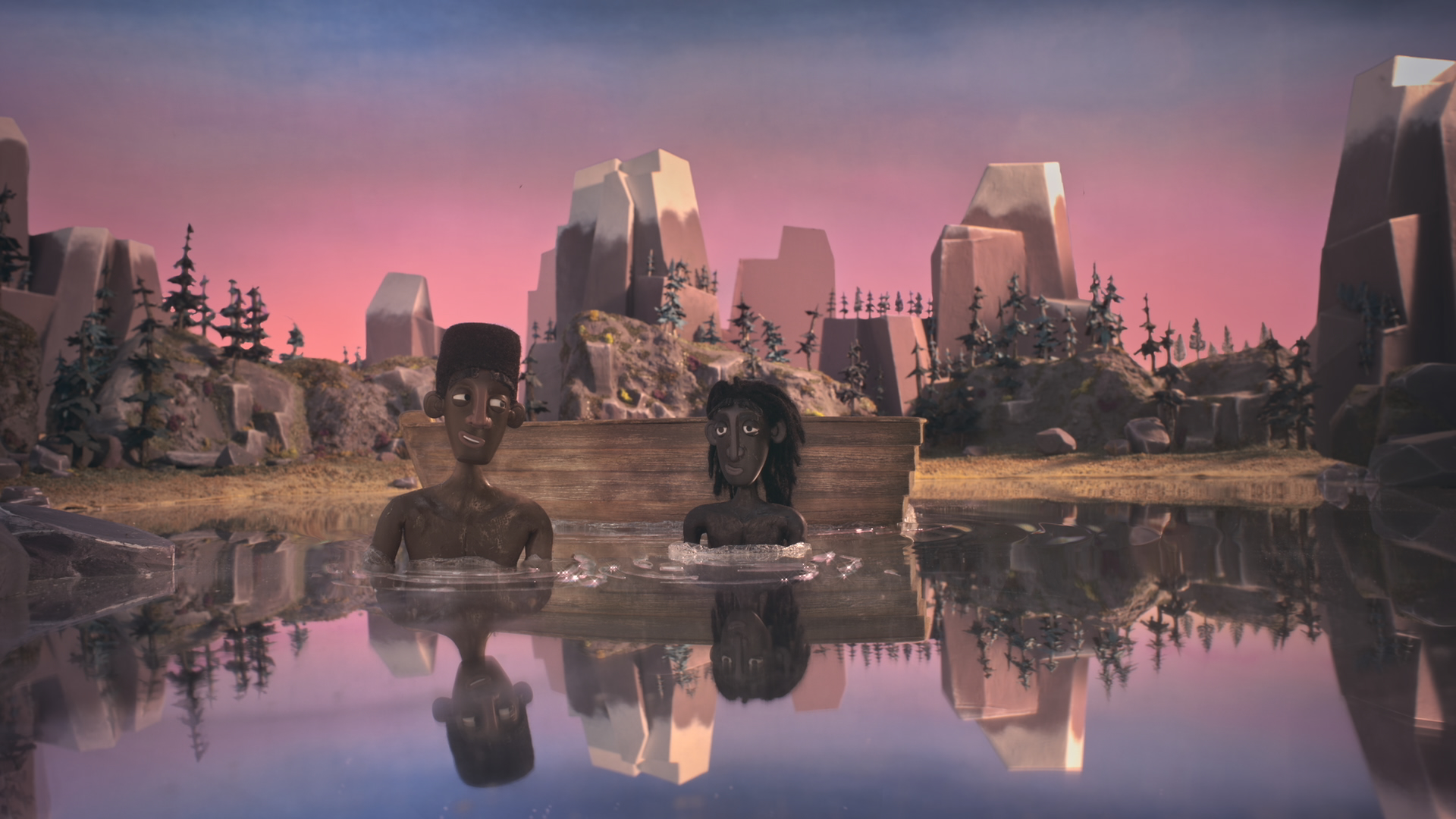
In their own way, all of the films in this year’s ‘Stop Motion Panorama’ display elements of all of this. And the opening film, Two Black Boys In Paradise by Baz Sells has them all. Five or more years in the making, it started when the film’s producer, Ben Jackson, a close friend of Sells’ and co-founder of their studio ‘One6th’, saw the poem of the same name being live-read at a poetry night in Berlin, loved it and realised this was the idea for the film he had been looking for. As a straight, white male, Sells was immediately alert to the pitfalls of directing a film about two gay, black young men. But its production synchronised with the period that Jackson had made the decision to come out as gay and while Sells says “it wasn’t always plain sailing”, the production process both drew from his experience watching his friend come out and built up their friendship as a result of the open and honest conversations that the experience provoked. The live-read of the poem itself is around two and half minutes, but in the film it spreads over more than eight to allow in the necessary space for the story and the characters to breathe. And if there is any one ‘little’ thing to watch out for?…. the water shots; water is notoriously tricky to animate in stop motion and there are a multitude of ways to do it. The way Sells has gone about it here is beguiling.
Estonians have a particular cultural connection to puppets and figurines. In Tallinn, they have one of the few – if not the only – full time, dedicated puppet theatres in the world. Venture south-east to the city of Tartu and you will get the opportunity to visit one of the most jam-packed toy museums you will come across and as often as not the exhibits are presented more as artefacts than playthings. In 2016, Ulo Pikkov borrowed from the museum a collection of wooden toys carved by an Estonian soldier in exile and used them to make a film called ‘Empty Space’, a kind of reverse tribute from the soldier’s daughter to her dead father. Mari Kivi, the maker of the second film in the programme Eating Time hails from Tartu although she made this film in the Nukufilm Studio in Tallinn. Nukufilm sets are always a sight to behold. Last time I was there, they were shooting a kind of ‘Noah’s Ark’ film and the set of the interior of the ark had to be at least four metres long and contained dozens of individual movable characters. Some of the sets, particularly the external ones, on Eating Time are equally heroic! But even within that scale, the power of the female characters at the centre of the film stands out. Designed to look like broken clay, they exude a weight and a kind of ‘solid fragility’ in every frame. Getting clay (or clay-like) characters to appear to eat is a difficult sleight-of-hand magic trick that few animators even attempt but in this film Kivi pulls this off in one particular scene with a skill and dexterity that is the equal of some of the shots in Svankmajer’s ‘Dimensions Of Dialogue’ (1982) that it reminds me of. It is all the more remarkable that this film was made without a storyboard, which must have also been a source of bemusement (if not a little confoundment) to the assistant animators at Nukufilm.
If Kivi’s character has a vast world to roam around in, the lead characters in Niko Radas’ Psychonauts seems to be condemned to a series of physical or mentally claustrophobic spaces that offer little relent from an electronic opera of varying disorders which normally ‘dare not say their name’. Whether this represents release, an inventory of despair or an eerie catalogue of existential, if far off, hope is probably up to you and what your experiences have been with these kinds of conditions. The fact that it was made with the help of patients at a psychiatry hospital as part of an art therapy workshop might, perhaps, point towards the latter.
The gear-change to Double Or Nothing by Tokay Sirin could hardly be more extreme. This is a jet-fuelled, true(ish) crime, nourish gangster caper film set in a 1980’s Japan boiling with fast money, massive ambition and a greed-as-good ethos leaking out through all the cracks in the overstuffed edifice. It centres around the colourful, real-life character Akio Kashiwagi who lived larger than any of them and died the same way, with nobody being able to say for sure which one of the 150 stab wounds that were administered on him was the fatal one….. so many to choose from! Our hero has stepped into this hot acid cauldron tasked by his boss to bring back a pile of money Kashiwagi has stolen from him; an unlikely clue regarding an aquarium shop being the only lead. The puppets and sets are great but the beating heart of this film is its brilliance at building a full head of steam as a psychological thriller and using the final vapours of that venting steam to conjure up an end to Kashiwagi’s story that only a few people know for sure. Getting this kind of speed, film pacing and acting out of puppets is rare and Double Or Nothing damn near sits in a class of its own by pulling it off with energy to burn.
In a similar fashion, Bruno Collet shovels the ‘sinister’ into his new film Atomik Tour. Initially it depicts some idiot influencer stumbling around the Chernobyl nuclear disaster site live-streaming what he and his followers mistake for ‘thoughts’ on the subject, all the while not being entirely frank about the fact that he’s there as part of a bus tour. In this phase of the film it is the framing being used that stands out; a clever way to use the aesthetic of watching everything through or on a phone as a basis for multiple but varying views of the world the film is set in. But at a certain point, Collet starts channeling the spirit of Fritz Lang and Jack Arnold’s love child and the switch goes to dark, strange and other worldly. It’s also when the under-lit, black & white visual toning of the film really hits its full stride.
The production trajectory for As Weary Wings Go By is nothing short of extraordinary and must have been physically demanding to pull off. It is the latest film from Estonian animator Anu-Laura Tuttelberg but it took three years to make. It is all shot outside, using puppets positioned and being animated in real wilderness environments in the middle of winter. It took three winters to get all the footage that Tuttelberg needed for the completed 10 minute film and every frame must have been a battle. Outdoor shoots always bring the variables of ever changing light, weather induced movement within the shooting frame and challenges in working on natural surfaces such as sand or snow. As Weary Wings Go By didn’t just face all these challenges and more, it seems to have baked them into the very essence of the story. It feels cold and bleak, the wind is adopted as something of a character in its own right, being given some scenes of its own to show us how it contributes to the icy ballet of it all. It is all shot on 16mm film which Tuttelberg credits with bringing “a special feeling of materiality and texture” to the film and the overall effect is more akin to coming across as a kind of visual poem more so than a straight or specific narrative, which is exactly what Tuttelberg was aiming for.
“While animating puppets in nature the light conditions change constantly in the background,” she explains. “The smooth animation of the puppets versus the hectic changing nature around them creates a peculiar presence of time passing by rapidly and brings out the essence and charm of the stop motion technique.”
Her next film, she says, is going to be about spring!
The Wickywock And The JubJub Berry by Cat Johnston and Joseph Wallace is the kind of film you get when you have on board somebody that really knows how to push words around. Funny, spooky, ironic, clever and never resting on its laurels or waiting for a zinger line to ferment, this is a film of image chasing language and it is delivered with a kind of consummate skill that makes the entire enterprise look like child’s play. There is an electric theatricality to it that draws some of its lessons from the ghost of music-halls past with a few sprinklings from the sweeter end of the demented Tim Burton line scattered around for seasoning.
You have to be of ‘a certain’ age to think that the technologies that allow puppet animators to routinely remove or mask out anything in the frame they don’t want there is worth remarking on. It’s a great thing that we have gotten to that point but the rise of those technologies made a type of story possible to tell in stop motion that previously had not always been the case. Tethered by Alessandro Cino Zolfaneli is an example of this. Central to the story is a young boy who is prone to floating off into space at inopportune moments. Done properly – as it is in Tethered – this is a type of movement that is done in three parts. The character must first float up and this is not just a matter of lifting them off the ground; they must wriggle and are usually fighting the process all the time expressing fear and surprise. Then they arrest the rise by grasping onto something, again usually fighting the risk of continuing to float any further whilst struggling to hang on to whatever they have grabbed. And then they fall or float back down to the ground. Animating these movements with authenticity takes a great deal of skill but getting rid of all the rigs that hold them in place on the animation set is where the technology cuts in and although now ubiquitous it was not always thus meaning, in turn, nobody would have tried to make a film like Tethered.
And the programme wraps up with a gem. Murmuration by Janneke Swinkels and Tim Frijsinger is a film of many moving parts, no pun intended. Set in an age care facility, it absolutely nails every single inch of the vibe of that space. In fact, the filmmakers have been told by people from all round the world (and I’m happy to confirm) that the age care home they’ve created is just like those you get anywhere you go. They have also done an especially good job of capturing the skin tone of all the characters, an aesthetic that even holds in close up. But the thing that really makes this film work so well is the time they have built into the narrative arc to let us get to know and experience the transition of the lead character with a dignified empathy that we would reserve for somebody we cared for in real life. This gives the film time to grow around us and let us gather our thoughts as we watch him slowly transition from man to bird. And that depth of connection to the character (certainly as a man) is all the more poignant because in the end, it is hard to know if we should be happy for him that he has found a new version of himself, saddened for him that the transition is such an unnatural one, inspired by what might be his escape or dismayed that he may be flying into a world he cannot escape and which might not be real. You forget these are puppets made out of foam stuffing covered with pantyhose!
A lot of great stop motion got submitted this year; too much to be contained in a single programme which says all you need to know about the relative state of what was long ago described as a dying art. I wouldn’t be breaking out the hymn books just yet.
Malcolm Turner
International Competition Programme 6: Stop Motion Panorama screens at The Puppet Theatre Barge Thu 4 Dec and online from the same date (available for 48 hours)











Leave a Reply
You must be logged in to post a comment.