
Every place has it, of course, but there is a particularly quintessential form of charm that manifests itself amongst those who inhabit these shaky Isles. There is a warmth to it that is genuine and replaces the chill often in the air. There is a depth to it that has evolved from centuries of a quiet maturation of the form bringing with it a certain facility with the mother tongue. My first encounter with Elizabeth Hobbs at the Ottawa International Animation Festival many moons ago was closely followed by a social media post mentioning a meeting with the ‘Splendid Malcolm Turner’. Back at home base the tag stuck and, ever since then, I’ve been patiently biding my time to return the favour.
We’ve been showing Elizabeth Hobbs’ films since we went chocks-away on LIAF back in 2003. But she’s been making them for longer.
Elizabeth studied Illustration at the Edinburgh College of the Arts, graduating in 1992. Initially that led to making prints and artist’s books but when she started writing short stories for some of those books it wasn’t long before she wondered how these could translate to an animated film. She borrowed a camera from a community video organisation and, using fuzzy felt as her medium, made Glenda and saw it screened at the Edinburgh International Film Festival in 1998. A one year postgrad diploma in Electronic Imaging at Dundee followed and her animation career-proper was launched with the release of The Last Regret Of The Grim Reaper in 1999.
‘Persistence’ is a word that keeps coming up when contemplating Elizabeth’s practice. Persistence in pursuing an idea, persistence in making the time and space[s] to create her films and persistence in living a life that has to blend family into the whole mix. Humour, a joyful form of collaboration, an utterly unique talent and – hey – charm, are the ways that bubbles up as she makes her films.
“Lizzy’s work, much like Lizzy, is hilarious,” says Abigail Addison, the Animate Project’s producer who has worked with her on five of her films. “Her films are so funny, almost slapstick at times, surreal at others.”
“There’s no one quite like Lizzy Hobbs,” echoes Jelena Popović, the National Film Board of Canada producer who co-produced her 2018 film I’m OK. “A marvellous minimalist working at the crossroads of storytelling, visual arts and history, all infused with a generous dose of humour.” Oh man, I wish I’d written that!!! “My admiration for Lizzy’s animated cinema is endless – I return to her films again and again, and each viewing feels like the first. And time and again I come to the same conclusion: each of her films is yet another mind-blowing empirical art experiment exploring a little-known corner of the humanities”.
“I feel very lucky to have been on this journey with Lizzy and it’s great to see the recognition she and her films are getting,” says Mark Jenkins, her editor of more than a quarter century. “She definitely has a unique style within her animation technique – painterly, free and flowing, but I also think she finds these amazing stories; historically and culturally interesting, quirky, funny, sometimes dark or sad, but ultimately bringing some form of understanding, something to think about after the film’s finished.”
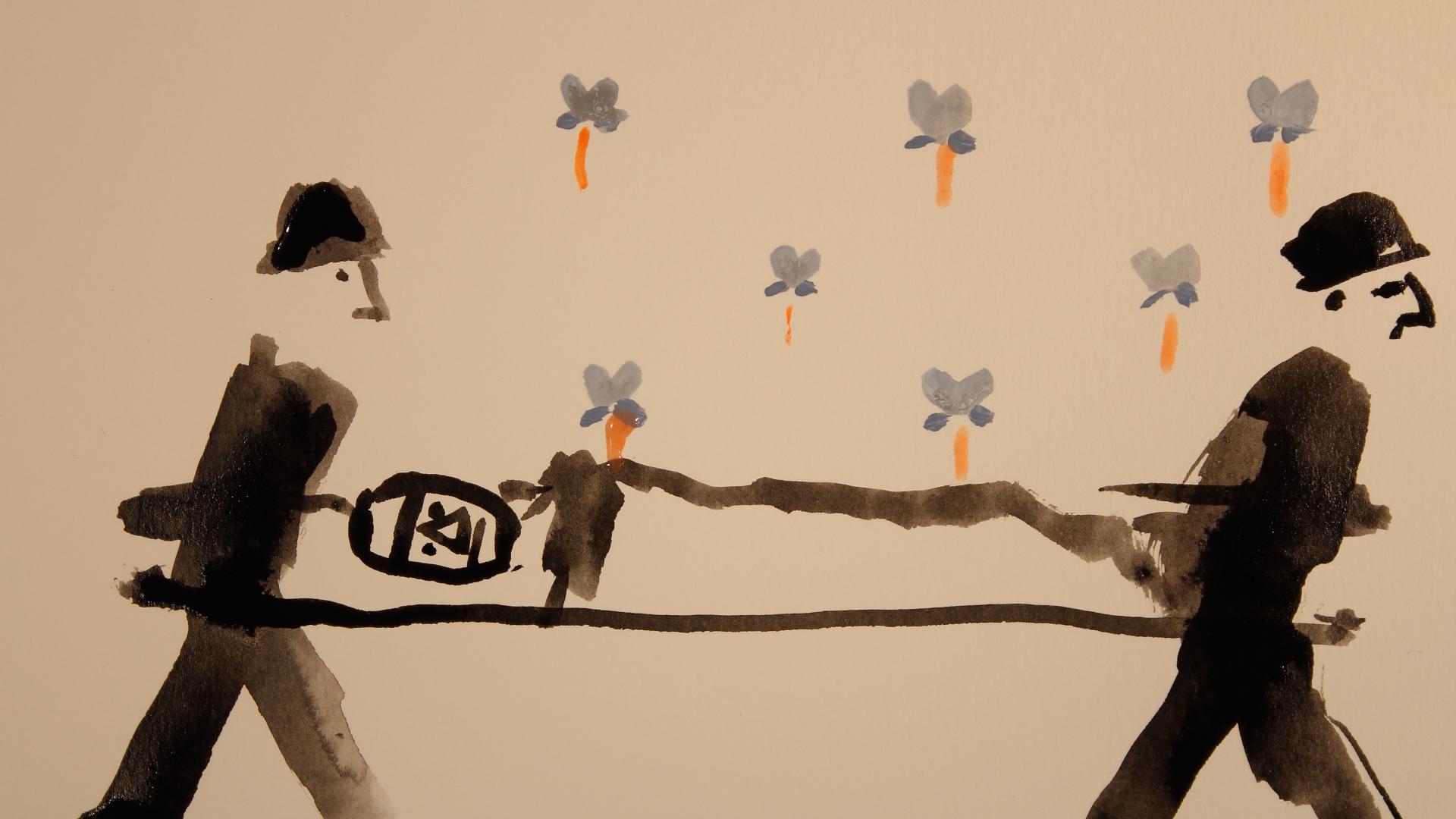
Elizabeth’s films are handmade – they are the living epitome of handmade! The electrically charged linework straight from her hand to your eye, the carnival of hectically electric paintings strung together to produce a story and characters that dive into a wonderfully parallel ‘real-plus’ world and a colour palette that provides the magic carpet that flies us through it all. These are the foundational components of Elizabeth’s animation.
Over the years, Elizabeth’s films have evolved from being animated ‘straight ahead’ (sometimes also referred to as ‘under camera’) to ‘frame by frame’. In the former, the animator places a painting under the camera, shoots it and then repaints some part of it for the next shot, continuing this process until the scene is completed resulting in a single artwork that has been subjected to all of these incremental alterations. Frame by frame on the other hand requires an individual and whole painting for every frame that is shot – typically (but not always) it takes twelve of these to make a single second of animation, thus hundreds if not thousands of paintings for a completed film.
Delivering a masterclass at the Animateka Festival last year, Elizabeth talked about this process in more detail, outlining that she moved away from ‘straight ahead’ animation because she felt it could get a “bit stuck” but when you’re working frame by frame there is a kind of ‘liveliness’ to the images that is “so nice, you really feel like it’s on fire the whole time”.
“I really enjoy the energy that comes from working frame by frame,” says Elizabeth more recently, adding “I’m still working out if perhaps I can use that energy a little more sparingly.”
The colours in Elizabeth’s film…. sing! They play, they push, they explain, explore and expand, they define, confound, confuse and delight. Is this planned, accidental or a mysterious but trusted process?
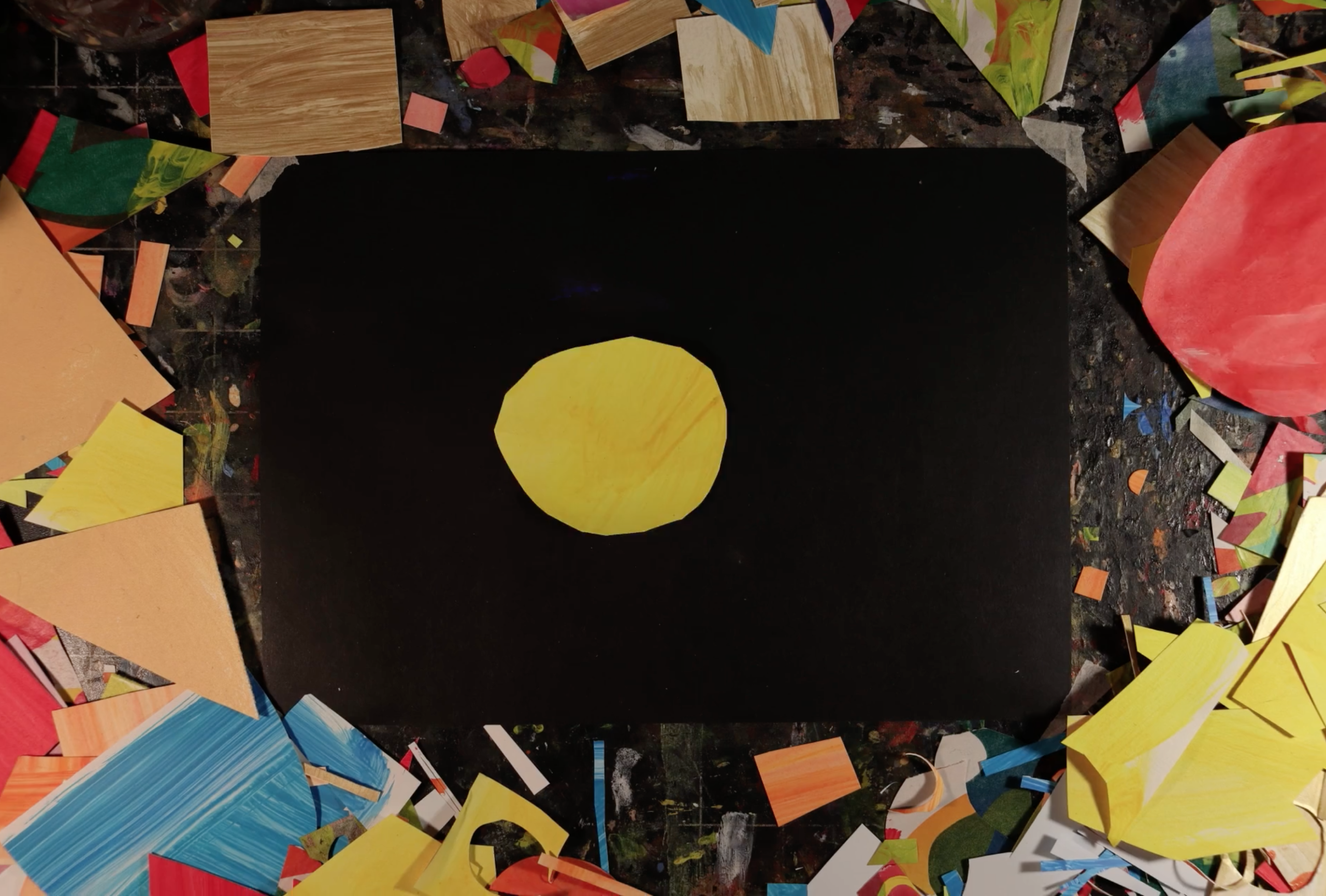
“The colours are chosen but like everything that happens under the rostrum I tend to have a go, and then revise or reduce,” she says. “Recently I tend not to use colour to indicate the colour of the clothes or backgrounds but rather to provide a way of waking up the audience, or signalling a strong feeling.”
All of this requires a lot of paper and increasingly her films tend to hint – or even overtly utilise – a range of base materials. It turns out that there is more than a solely artistic purpose behind these choices. “I do have favourite papers, but recently I like to use the back of certain cereal packets (malt wheaties) or offcuts of mounting board. I want the films to be as light on the environment as can be.”
Constructing a picture on the logistics of Elizabeth’s animating practice is a slightly more elusive goal to try and realise. Perhaps, flexible is a better word. It probably has as much to do with the ways in which such animating ‘necessities’ such as scripts and storyboards impact on artists and collaborators in slightly different ways.
“I do use scripts and storyboard to communicate what I’m hoping to do to potential collaborators,” Elizabeth offers. “But on the whole I will try to get as quickly as I can into animating a scene because that’s where I discover quite a lot about the characters and the story – when they’re on the move.”
Good producers possess the ‘trust gene’ and know how to apply it to the right artists to simultaneously free an artist, apply the right reins on an organic process and harness a great result.
“Working with someone like me means she has to write her fantastical ideas down into a script so that we can convince other people to back the idea,” outlines Abigail Addison, Elizabeth’s producer at Animate Projects. “We spend a lot of time discussing the dialogue, characters and story structure from the start, and talking to our collaborators and co-producers to hone the idea as we go.”

“Lizzy spends a lot of time experimenting with drawings and collage early on to settle on the style and colour palette, and there are key images that she starts with that set the tone for the work like the fisherman and his wife filling their tiny hovel in The Flounder”, continues Abigail. “During production she might suddenly throw in an unexpected touch like the real hand lettering in Daughters of the Late Colonel. Lizzy often reproduces the same shots several times until she is happy with them. Leaving space for visual elements to be able to change is an important part of the process.”
Jelena Popović, the NFB co-producer of I’m OK, had her own front row seat in this creative pathway.
“I became part of Lizzy’s process from within, which was an extraordinary privilege,” says Jelena. “What I can certainly say is that I got lucky to see her home studio where she creates her films. And I saw her creative process evolve without losing a single atom of the film’s core, as expressed in her very first outline of the idea proposed to the NFB.”
All of that being said, a lot of footage seems to get created which never makes it into the finished films. In theory, ‘locked’ animatics conspire against this and – in theory at least – are there to ensure that by the time animating actually happens the process is as thought through and ‘efficient’ as possible.
At the Animateka Festival masterclass Elizabeth said she made more than 15 minutes of footage for Daughters Of The Colonel that never made it into the film. That is a lot of unused animation! In discussing this, she laid out the importance of her long term editor, Mark Jenkins to her finished films.
“I make all this footage and the editor has to bring all this ‘BLEH’ together,” she told the assembled masses, some of them visibly shocked at the revelation, your humble scribe among them.
“I heard Lizzy said that,” Mark told me. “But I don’t think it’s true.”
It turns out he is simpatico with Lizzy’s Modus Operandi. “I was used to editing docs and dramas so this idea of a locked animatic seemed crazy to me. Once you have a frequency within the frame, whether through the image or the sound, the rhythm changes. So it’s impossible to second guess that rhythm until all the elements are there. So working with shots rather than an animatic felt more natural, and I think Lizzy liked the freedom of finding her rhythm and painting shots and scenes.”
Her current film Daughters Of The Colonel is but the latest addition to a continuing body of work that suggests that – really – it’s time to go past thinking of Elizabeth Hobbs simply as a fine contemporary animator and start looking at re-tuning our antennae to contemplate her as a director that will stand among the true greats of our artform.
All in all…. splendid!
Time and space hinders an attempt to go into much detail regarding the programme of films Elizabeth chose as among those which have offered her inspiration over the years but in a succinct paragraph she broke them down into a few categories as to what they mean to her.
“There are so many animators who are influential so a 30 minute programme was really tricky,” she began. “In the end I tried to choose films that somehow do more with less and also seem to reward numerous re-watches. Most of the pieces are made with paper, paint, pens. Some of the pieces, like Cannon Fodder, Tub Film, Fruit Fruit and Glazing are so economical! Fruit Fruit and Glazing have particularly brilliant sound. Others like Juke Box, Damon The Mower and Fragments use loops and they all hold some kind of mystery to me. There are others, like Hold Tight and NightHawk in which there is an expression of something personal or specific which I enjoy learning about. The longest pieces, 78 Tours and NightHawk are films that I consider extraordinarily masterful, I just love watching them both and I felt they would be really good in this programme.’
Malcolm Turner
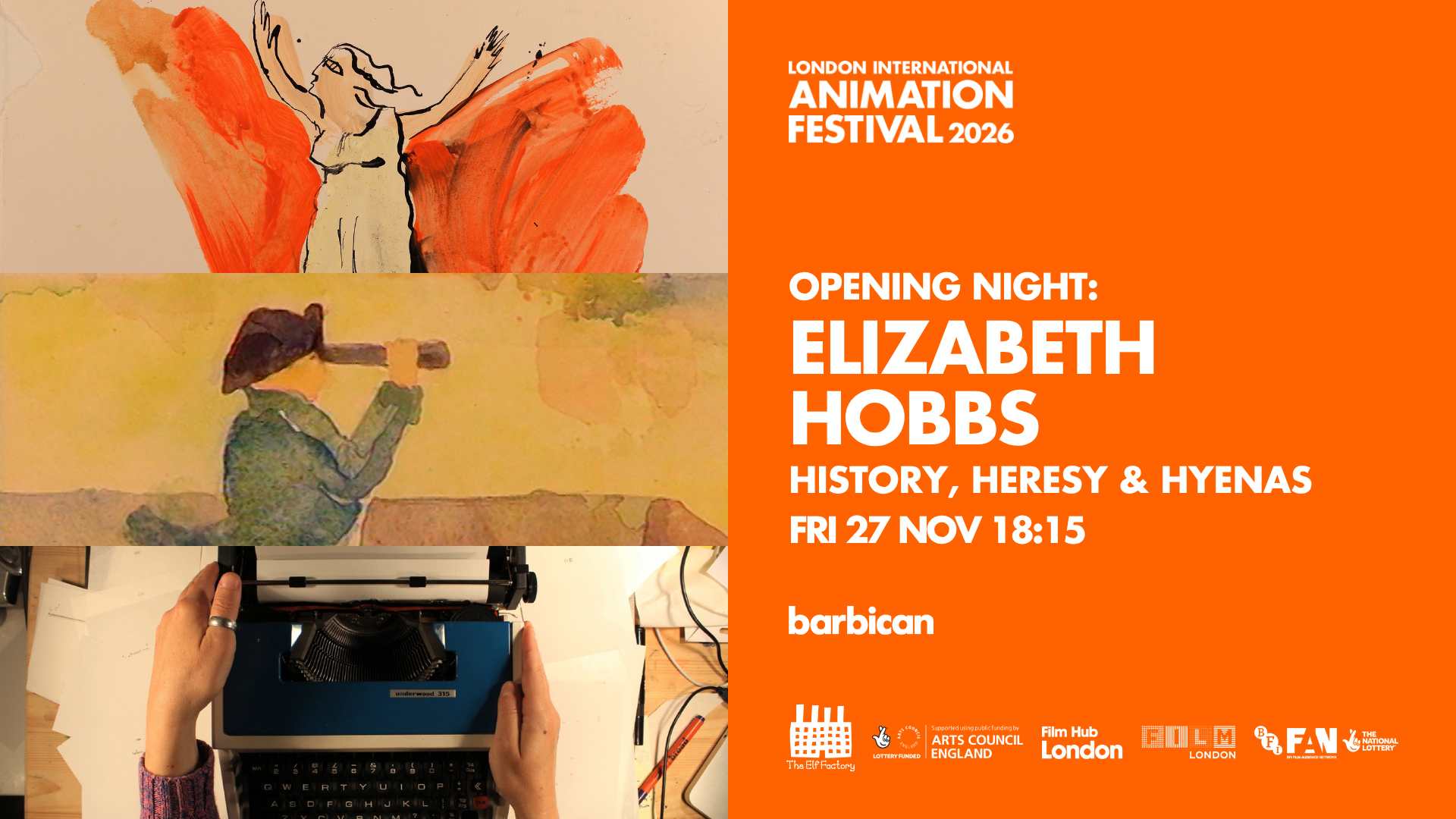
Elizabeth Hobbs: History, Heresy & Hyenas + Screentalk opens LIAF 2026 at the Barbican Fri 27 Nov. The Splendid Ms Hobbs has hand-picked 30 mins of films that have influenced her work. We’ll follow with an hour of her own brilliantly inventive films. Then, Lizzy will take to the stage to share the stories, inspirations and mischief behind her extraordinary body of work.










Leave a Reply
You must be logged in to post a comment.